I have often been fascinated by how marketing and sales influence the direction of a technology. A compelling demonstration can change what customers ask for. Those questions can then shape development priorities, investment and the next generation of manufacturing equipment.
I remember following Velo3D’s messaging around support-free metal printing and the discussions it generated on LinkedIn, in industry magazines and among AM enthusiasts. With my own research focused on support-free overhangs, that conversation felt particularly close to home. Velo3D presents its SupportFree capability as part of an integrated system involving hardware, software and process control. [21] To me, it was a vivid example of technical ambition becoming a commercial conversation.
Bold claims invite scrutiny. They can also encourage customers and competing machine manufacturers to ask whether familiar design limits can be pushed further. I would not credit one company with every advance in this field, but I do think the way we communicate a technology helps shape what the industry expects from it.
When I look beyond the machines shaping additive manufacturing, I keep coming back to the materials they use. Does feedstock receive enough of the spotlight?
There is certainly no shortage of powder research. I have read hundreds of papers and know researchers who have devoted years to understanding powders and making their production, characterization and use more dependable. Yet I often feel that this work becomes a specification in the background while the machine or finished component carries the story.
So, grab a coffee and join me for a closer look. This article follows powder from the research and production work behind it to the businesses that depend on it: aviation, space, defense, marine, healthcare, industrial manufacturers and the local bureaus bringing someone’s first prototype to life. My hope is that, by the last sip, the powder producer feels less like an anonymous supplier and more like a partner in what manufacturing can achieve next.
For me, helping America build again means expanding the ability to manufacture dependable parts, from critical industrial components to the prototypes and small production runs that help new businesses grow. Powder suppliers have a role in that effort whenever their materials support a viable manufacturing process.
Powder quality is engineered before printing begins
Before metal powder reaches a printer, substantial engineering has already gone into controlling its composition, producing and classifying the particles, and verifying each batch. Handling, packaging and storage must then preserve those properties. The producer’s challenge is to deliver the required quality consistently, batch after batch.
There is no universally perfect powder. Particle size distribution, morphology and chemistry must suit the intended manufacturing route. ASTM’s characterization guide addresses new and used metal powders, while NASA places feedstock control within broader manufacturing and qualification requirements. [2] [3]
Consider a load-bearing medical implant or an aerospace component subjected to repeated loading. Both require evidence that the manufacturing route can deliver the specified material properties. Powder suppliers contribute through consistent batches, traceability and documented test results. When a build falls outside expectations, those records help engineers assess whether feedstock contributed to the problem. The value is dependable material, backed by evidence the customer can use.
The business value beyond price per kilogram
That engineering contribution needs a commercial explanation. Price per kilogram is easy to compare; the cost of evaluating a new material, investigating a rejected build or waiting for a delayed shipment is less visible in a quotation.
I would start with the customer’s cost per accepted component. Alongside powder purchases, that includes processing, finishing, inspection and rework. A supplier can make a stronger case by showing how its material and service fit those requirements, with evidence from relevant trials. A higher powder price needs a demonstrated benefit; a lower-cost material that satisfies the requirements may be the right choice.
The conversation also needs to begin early. Material family, manufacturing route and acceptable supply sources may already be fixed when procurement requests a quotation. Involving the supplier during development allows the teams to agree what must be demonstrated and whether an alternative source is practical.
The commercial opportunity begins with a manufacturing problem worth solving. The next question is where those problems occur, who buys the material and whether demand will repeat.
A growing AM market creates different powder opportunities
The Wohlers Report 2026 release puts global additive-manufacturing revenue at US$24.2 billion in 2025, up 10.9%. Printing services represented 48%, systems sales and servicing 26%, materials 20%, and software 6%. Printing services grew 15.5% that year. [1]
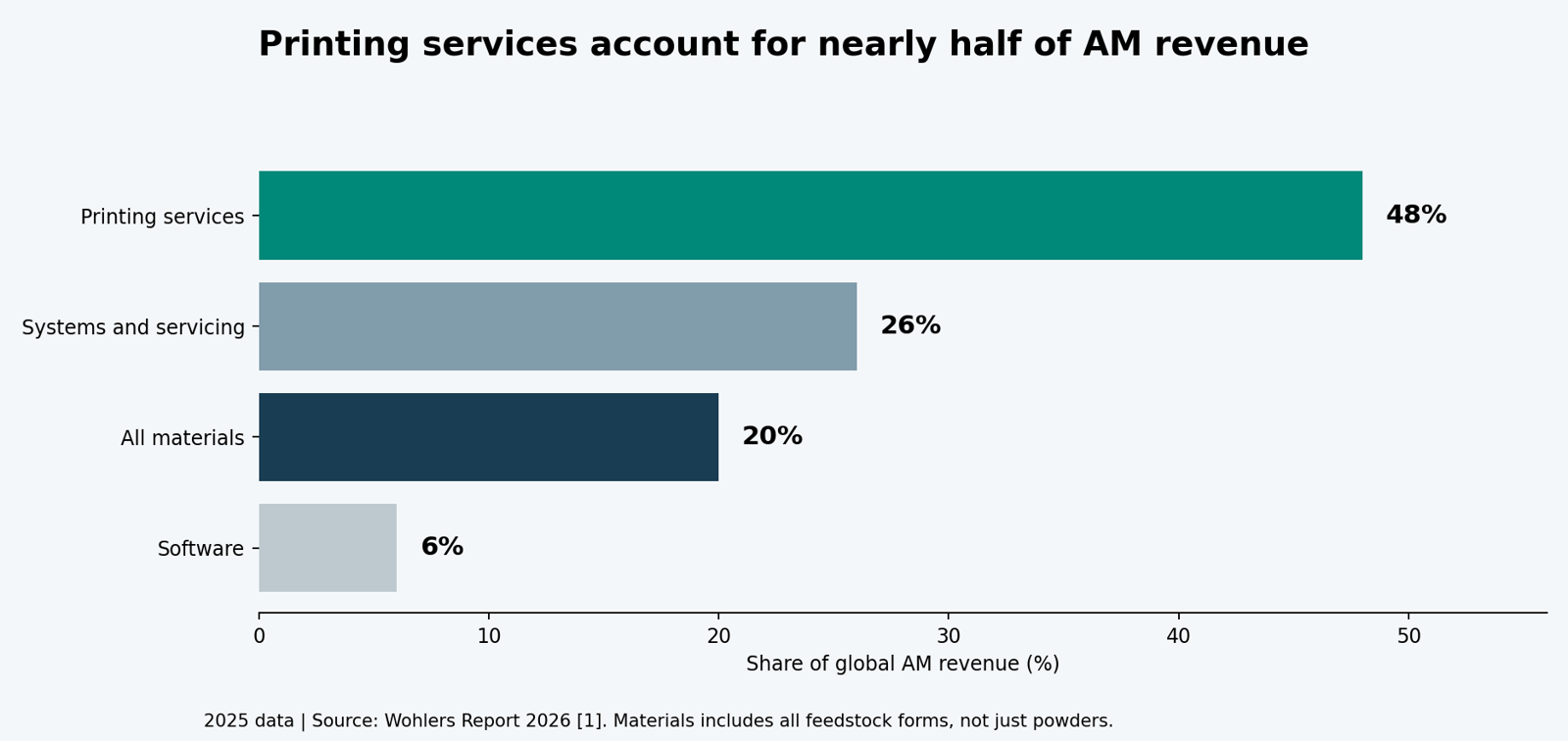
Figure 1. Global AM revenue composition in 2025. Source: Wohlers Report 2026 public release [1]. Revenue shares across AM, not powder-consumption shares.
The materials share implies approximately US$4.84 billion for all AM materials, calculated from rounded reported figures. These data describe global AM revenue, not the U.S. powder market or sector powder tonnage. They show the scale of the surrounding industry without establishing which sectors buy the most powder.
What interests me is how growth reaches the supplier. A service business is a prospect when it operates a compatible powder process, has active customer demand and needs replenishment. Its total revenue or printer count cannot answer those questions on its own.
Medical and aerospace are end-use sectors; service bureaus and print farms are production businesses that may serve several sectors. A hospital may buy an implant while a contract manufacturer buys its powder. Keeping those roles separate prevents double-counting and identifies the actual customer.
This opportunity also extends beyond metal. Engineering polymer powders, foundry sands and technical ceramics serve different processes and buying needs. Filament, liquid-resin and wire-fed businesses are not automatically loose-powder customers. The sector discussion below uses broad material families and distinguishes established application areas from prospects that still need evaluation.
Where powder can create value across industry
This is where the story becomes broader than a few headline applications. An aircraft supplier, a dental laboratory and a foundry may all purchase powder, but they are buying it to solve very different problems. The sectors below combine documented applications with clearly identified prospects. The material families are illustrative, and the commercial observations are my interpretation of where suppliers could build useful relationships.
Aerospace and civil aviation
Aircraft structures, engine components, thermal systems and production tooling create different requirements. Titanium- and aluminum-based families address lightweight designs; nickel-based families support high-temperature applications. Polymer powders can serve suitable prototypes and production aids. EOS documents aviation applications, including turbine components. [12] For business development, distinguish flight hardware, ground equipment and development parts. Ask which program owns approval, what the production rate is, and whether a second powder source can be introduced. A large aerospace account is not one uniform buying opportunity.
Space and launch systems
Space deserves its own commercial treatment. Relevant families include lightweight metals for structures and nickel- or copper-based materials for selected propulsion and thermal applications. [4] [5] The supplier should separate engine-development campaigns, satellite programs and recurring launch-system production. The same customer can move between irregular trials and scheduled builds. Qualify demand through funded milestones and actual replenishment rather than public launch ambitions.
Defense and national security
Defense extends beyond military aviation into land and naval equipment, drones, maintenance and spare parts. EOS identifies both new-product and sustainment applications. [6] The powder portfolio may include ferrous, lightweight and high-temperature metal families, alongside suitable polymers for support applications. Commercially, identify the program authority, approved manufacturing route and supply requirements. Budget announcements are not material orders; an approved production plan is a more useful sales signal.
Marine and shipbuilding
Commercial ships, naval vessels and offshore equipment require a separate opportunity map covering new parts, repair and replacement supply. EOS lists nickel-family applications in shipbuilding and marine environments. [5] Ferrous and selected corrosion-resistant nonferrous families are candidates to evaluate for individual applications. The supplier’s value proposition should address the operating environment, testing and acceptance route, and cost of vessel or equipment downtime. Verify that the selected manufacturing process actually uses powder: a large wire-deposited marine component does not generate powder demand.
Medical devices and healthcare
Medical demand includes implant manufacturers, surgical-device producers, contract manufacturers and selected hospital-linked production services. EOS documents metal and polymer applications in implants and surgery, including titanium- and cobalt-based materials. [13] Separate serial implants, patient-specific devices, instruments and nonclinical development models. Their approval pathways and buying patterns differ. Suppliers should establish lot traceability, agreed acceptance criteria and change-control responsibilities early. Qualification can support a durable relationship, but neither a medical material label nor customer approval guarantees purchase volume.
Dental laboratories and production centers
Dental should be evaluated separately from orthopedic and surgical manufacturing. For applicable metal workflows, investigate cobalt-based and titanium-based families; confirm the actual material-process combination with the laboratory. Resin-based models and other nonpowder workflows belong outside the direct powder forecast. The proposed commercial focus is repeat batch production, consistent fit after finishing, and dependable replenishment. Small parts can produce high unit counts with relatively low kilograms, so measure order cadence and service cost alongside tonnage.
Automotive and motorsport
Aluminum-based and ferrous metal families, together with engineering polymer powders, can support different automotive development and manufacturing needs. [4] [11] Distinguish functional prototypes, motorsport components, manufacturing aids and approved serial parts. Rapid development may reward delivery speed; serial production requires a demonstrated cost and capacity case. Vehicle production figures cannot be converted directly into AM powder demand.
Rail and other transport equipment
Rail, commercial vehicles and specialist transport fleets are adjacent markets to investigate for low-volume replacement parts, tooling and development models. Candidate families include engineering polymers and ferrous metals, subject to each component’s performance and approval requirements. This is an account-screening proposition, not a quantified adoption claim. Start with an obsolete or difficult-to-source part and compare AM with the existing supply route. Separate safety-critical components from interior, workshop and tooling applications.
Energy and power generation
Gas turbines and other demanding energy applications create opportunities for nickel-based and ferrous powders. [5] Nuclear applications warrant a distinct qualification discussion; EOS identifies AM opportunities in that sector. [14] Renewable-energy and hydrogen-equipment programs are additional prospects to screen for suitable thermal, flow-control and tooling applications, not assumed powder markets. Estimate new-build and maintenance demand separately and verify which parts have a funded route to approval.
Oil and gas and chemical processing
Nickel-based and ferrous families can address selected corrosion, temperature and process-equipment requirements; EOS documents nickel-family use in oil and gas and the process industry. [5] Candidate accounts include equipment manufacturers and qualified repair providers. The buying case should connect material evidence to service conditions, inspection and delivery needs. An emergency replacement and a scheduled production run require different inventory and pricing arrangements.
Industrial machinery robotics and tooling
General engineering, automation and tooling offer routes through mold inserts, fixtures, grippers, housings and thermal components. EOS documents manufacturing applications in these areas. [15] Ferrous powders include stainless and tool steels; other opportunities use lightweight metals, conductive metals or engineering polymers. A tool can improve a much larger conventional production line while consuming little powder itself. Sell the demonstrated manufacturing benefit and forecast material demand from the number of tools or parts actually printed.
Electronics semiconductors and thermal management
Copper-based and other application-specific metal families can support thermal-management components. EOS describes AM heat exchangers and cooling modules for semiconductor equipment. [16] For suppliers, the relevant buyer may be an equipment manufacturer or specialist thermal-design business rather than a chip producer. Evaluate thermal performance, cleanliness, finishing and production readiness. A compelling demonstration should not be presented as evidence of broad market penetration.
Consumer products sports footwear and jewelry
Powder opportunities extend into consumer goods, eyewear, footwear, sports products and jewelry, which EOS identifies among its application markets. [17] Engineering thermoplastics and elastomers are relevant categories; selected products also use metal families. The business case may depend on customization, comfort, appearance or short production runs. For suppliers, seasonality, finishing requirements and repeat product launches can shape demand as much as machine capacity.
Foundries casting and technical ceramics
Powder-based AM also supplies conventional manufacturing indirectly. Printed sand molds and cores support casting; printed patterns offer another route. ExOne documents these workflows and technical-ceramic binder jetting. [18] [19] Foundry sands, pattern polymers and ceramic powders must remain separate from the metal-powder market. Their purchasing and processing economics differ. The commercial buyer may be a foundry or mold-printing service rather than the company using the final casting.
Construction architecture and design
ExOne describes powder-based routes for architectural and construction applications. [20] Opportunities include models, molds and selected designed elements, using suitable sand, mineral or polymer feedstocks. Do not count all construction printing as powder-bed AM: extrusion-based building systems follow different material routes. For business development, identify whether the buyer wants a model, a production mold or an end-use element before estimating volume and qualification effort.
Agriculture mining food processing and packaging
These sectors deserve inclusion as adjacent opportunities for equipment spares, fixtures, grippers, prototypes and selected repair applications. Candidate categories include ferrous and wear-resistant metal families and suitable engineering polymers. This is a proposed prospecting map, not evidence of sector-wide adoption. Establish the specific operating environment and approval needs, including hygiene or contact requirements where relevant. The strongest starting point is a verified production or maintenance problem with a measurable cost.
Research education quantum and scientific equipment
Universities, laboratories, training centers and instrument developers can purchase small batches across metal, polymer and ceramic families. Their value may be experimentation, teaching or application development rather than recurring industrial tonnage. Quantum and cryogenic hardware belong in the emerging-opportunity category: screen potential housings, thermal components and test fixtures against purity, surface condition and operating-temperature requirements. Do not imply that powder AM is an established route for every quantum component. Pursue funded feasibility work before forecasting production sales.
AI-assisted design and process analysis are tools worth evaluating for screening geometries and organizing evidence. Their value must be demonstrated in the resulting manufacturing decisions; a generated design does not establish material compatibility or part qualification. For emerging quantum hardware as well, supplier involvement begins with a funded feasibility question.
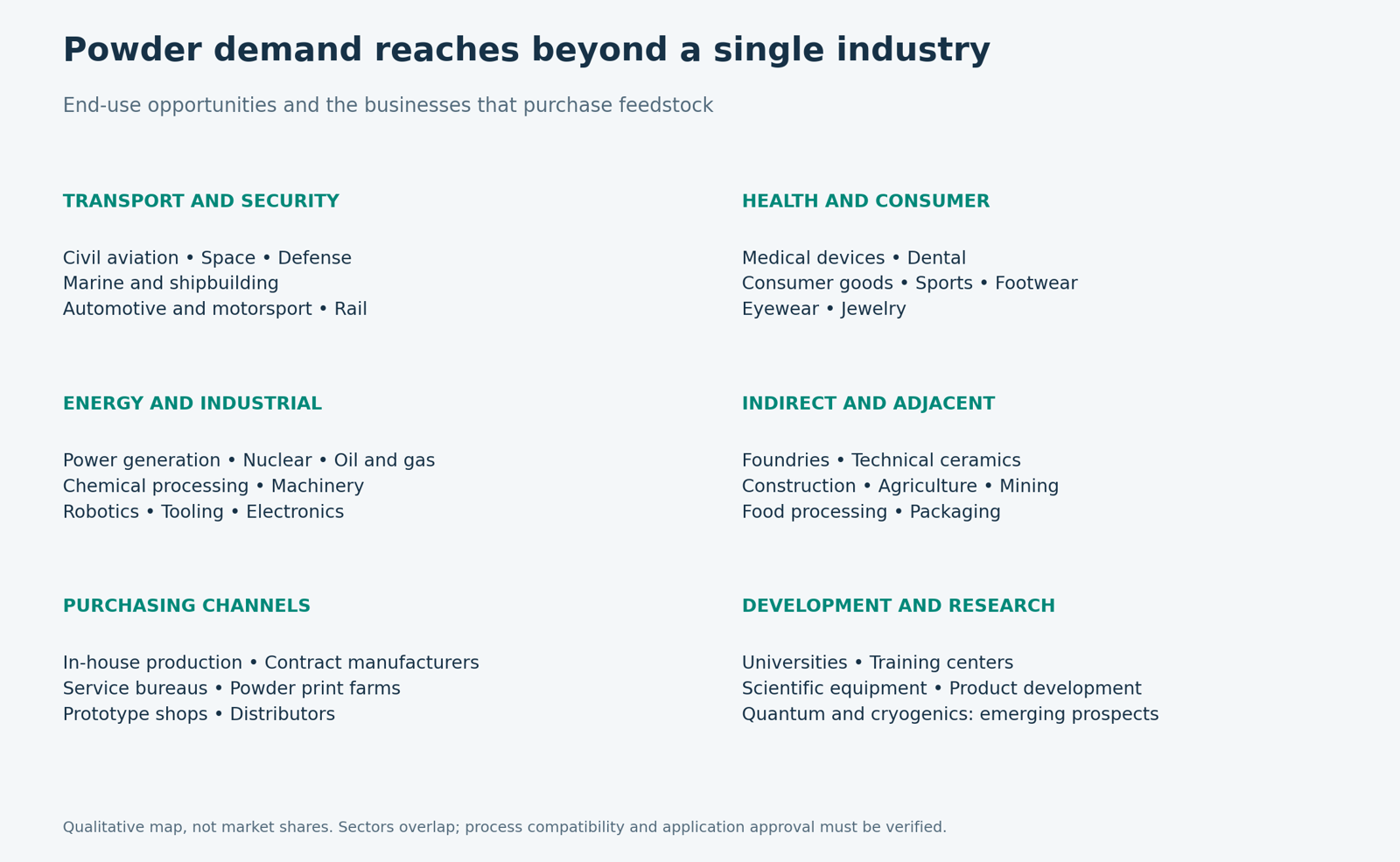
Figure 2. Broad opportunity map separating end-use sectors from purchasing channels. Includes documented applications and explicitly identified adjacent or emerging prospects; not a market-share chart. Sources [4]–[7] and [10]–[20]; commercial grouping is the author’s analysis.
Domestic prototyping businesses deserve their own strategy
I do not want the smaller businesses to disappear behind the aerospace and defense headlines. A prototype can be a one-time purchase for a designer while the bureau serving hundreds of designers buys material every month. This distinction makes domestic prototyping businesses commercially important even when individual jobs are small.
For polymer-powder services, investigate functional prototypes, product housings, mechanisms and small batches. SLS is used for prototyping and short-run manufacturing, with unfused powder supporting parts during the build. [11] Metal prototyping requires its own assessment of material, process and finishing needs.
For these businesses, I would want a supplier offer that combines reliable stock, manageable order quantities and responsive technical support. For the bureau, the business case is turnaround time and margin per accepted job. Quote preparation, customer revisions and finishing labor can matter as much as printing time. A material proposition should help the bureau deliver profitably, not merely reduce its purchase price.
Print farms buy utilization and consistency
Print farms deserve attention for the same reason. Here, I mean businesses operating multiple powder-capable printers. Service bureaus may use that operating model, but the terms are not interchangeable with a specific AM process.
My first questions would be how often builds run, which materials are used, and how much fresh powder the business purchases. Printer count alone is a weak demand indicator. Idle equipment consumes little; an active service bureau can aggregate many small customer jobs into recurring replenishment.
For the operator, useful measures include build utilization, packing density, accepted-part yield, finishing throughput and on-time delivery. For the supplier, add reorder frequency, contribution margin after support, and the customer’s ability to approve an alternative material source. Compatibility and approval constraints can limit the addressable opportunity even when demand is substantial.
Powder recovery and reuse connect both businesses. Better reuse may reduce fresh-powder consumption per part and improve the operator’s economics. Whether total powder purchases subsequently rise depends on production growth. The supplier should model that trade-off rather than assume that more printers or better reuse automatically means more sales.
How marketing and technical sales turn capability into demand
These different customer needs are where marketing and technical sales become useful. Marketing can make a manufacturing problem understandable and show what has been demonstrated. Technical sales can then bring the customer’s actual constraints into the discussion: the component, the machine, the acceptance criteria and the economics. Business development connects that conversation to the partners and applications worth investing in.
Consider a supplier approaching a service bureau. A statement about flowability may start a conversation; evidence from relevant trials, agreed test conditions and a clear account of what changed can help the bureau decide whether an evaluation is worthwhile. The useful commercial story explains the result, its limits and what the customer would need to verify.
Customer feedback should also travel back into development. A recurring problem with order size, consistency, documentation or delivery may deserve as much attention as a new material launch. That is where I find the relationship between sales and technology most interesting: the conversation can improve both the product and the way it reaches the market.
Build the business around repeat production
Once interest becomes an active evaluation, the commercial sequence is straightforward: identify an application, agree the evaluation criteria, demonstrate process compatibility, secure customer approval and establish repeat supply.
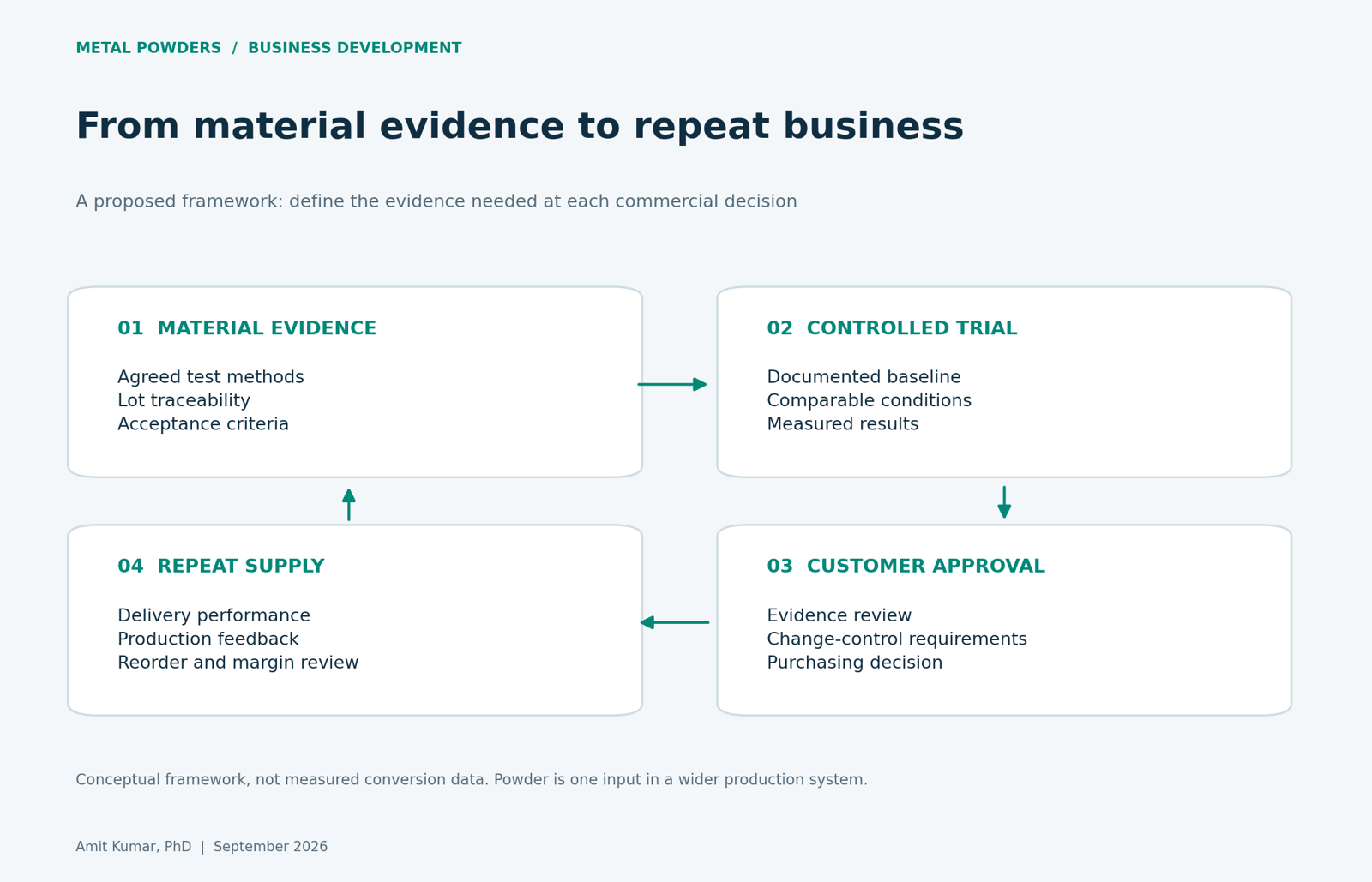
Figure 3. Proposed route from material evidence to repeat supply. This is a commercial framework, not measured conversion data or a claim that powder alone determines production success.
For each account, track annual fresh-powder purchases alongside the cost of qualification support and service. Powder charged into a machine is not necessarily consumed; recoverable material may return to later builds. Forecast replenishment from material incorporated into builds, unrecovered or retired powder and planned inventory changes.
The strongest opportunities have evidence of recurring need and a customer willing to make the next decision. A sample shipment with no trial owner, budget or review date is an activity, not yet a dependable revenue forecast.
Illustrative demand calculation, not market data: suppose one site incorporates 800 kg into all builds during a year, retires or loses another 100 kg, and increases usable powder inventory by 50 kg. With no external transfers or other inputs, purchases would be approximately 950 kg. Reused powder circulating between builds must not be added again. Actual forecasts must reconcile purchasing, inventory and loss records.
I would prioritize accounts using annual replenishment potential, approval effort, repeat-order evidence and contribution margin after support and logistics. A high-tonnage account is not automatically the most profitable; a low-tonnage customer is not automatically unimportant. Medical programs, marine maintenance and mixed-job print farms can each be attractive for different reasons.
Reliable supply supports American manufacturing
Repeat production also depends on access to material when it is needed. For U.S. manufacturers, I would assess the whole supply route: upstream feedstock, powder conversion, testing, inventory and approved alternatives. A local production address alone does not describe that entire chain.
Domestic powder producers and qualified Canadian or other partner suppliers can support U.S. production where sourcing requirements permit. Their business case should explain delivery capability, technical support and how changes in sourcing costs or availability would be managed. An approved second source is useful only if there is a workable plan for supply.
NIST identifies measurement science and standards as foundations for broader AM adoption, while America Makes connects industrial-base expansion with collaboration, workforce development and smaller manufacturers. [8] [9] My conclusion is that powder capacity should develop alongside the people and production capabilities needed to use it.
Giving powder its place in the manufacturing story
I began with a memory of how a technology story caught the industry’s attention. I would like us to tell the powder story with the same curiosity and with evidence that makes its contribution clear.
Behind a dependable batch are researchers, production teams, testing laboratories, application engineers and commercial teams. Their work becomes visible when an aircraft supplier, medical manufacturer, shipyard or local bureau can repeat a build, meet the required checks and deliver the next order.
Helping America build again requires dependable manufacturing capacity. Powder suppliers contribute by connecting material capability to viable applications and reliable production. That is a business story worth telling beyond price per kilogram.
If your coffee is finished, I hope the next printed component you see prompts one more question: who made the powder, and what did it take to make that material dependable?
References and data notes
[1] Wohlers Associates / ASTM International. “New Wohlers Report 2026 Values Additive Manufacturing Market at $24.2B.” 17 February 2026. Public release reporting 2025 results. Regional percentages are reported average company revenue growth; materials share includes all AM materials.
[2] ASTM F3049-14(2021). Standard Guide for Characterizing Properties of Metal Powders Used for Additive Manufacturing Processes. Citation refers to the public scope and significance statement, not a review of the paid standard’s full text.
[3] NASA. “NASA Additive Manufacturing Standards Support Human Spaceflight.” Overview of feedstock, qualified material processes, equipment and production controls.
[4] EOS. Metal Powder for 3D Printing. Manufacturer’s material-family and application overview; not market-share evidence.
[5] EOS. Nickel Alloys for Industrial 3D Printing. Aerospace, energy and process-industry applications.
[6] EOS. 3D Printing for Government & Defense. Defense application context; no powder-consumption ranking inferred.
[7] EOS. Cobalt Chrome for Industrial 3D Printing. Medical application and material context.
[8] NIST. Additive manufacturing. Measurement science and standards supporting industrial adoption.
[9] America Makes. Expanding the Industrial Base. Collaboration, workforce development and adoption by smaller manufacturers.
[10] Formlabs. Guide to 3D Printing Materials. Feedstock distinctions between FDM, SLA and SLS.
[11] Formlabs. Selective Laser Sintering 3D Printing Complete Guide. Polymer-powder workflows, prototyping and small-batch applications.
[12] EOS. 3D Printing for Aviation. Manufacturer application overview; not market-share evidence.
[13] EOS. 3D Printing for Implants and Surgery. Manufacturer application overview; not market-share evidence.
[14] EOS. 3D Printing in Nuclear Energy. Manufacturer application overview; not market-share evidence.
[15] EOS. Industrial 3D Printing Solutions for Key Industries. Manufacturer application overview; not market-share evidence.
[16] EOS. 3D Printing for Semiconductors. Manufacturer application overview; not market-share evidence.
[17] EOS. Consumer Goods. Manufacturer application overview; not market-share evidence.
[18] ExOne. 3D Printed Sand Casting Molds and Cores. Manufacturer application overview; not market-share evidence.
[19] ExOne. Technical Ceramics 3D Printing. Manufacturer application overview; not market-share evidence.
[20] ExOne. 3D Printing for Architecture and Construction. Manufacturer application overview; not market-share evidence.
[21] Velo3D. Sapphire. Manufacturer description of SupportFree capabilities and integrated hardware, software, monitoring and process features. Cited for the company’s stated capabilities, not proof of historical priority or competitive causation.
Scope: U.S. commercial opportunities across powder-based AM and associated supply chains, including metal and polymer powders, foundry sands and technical ceramics. Adjacent and emerging opportunities are explicitly identified. This is a broad sector map, not an exhaustive application catalog or proof that every proposed part is qualified. Conventional powder metallurgy is outside scope; powder-containing formulated feedstocks are distinguished from loose powder. Recommendations and the demand example are the author’s analysis. Revenue data describe global AM in 2025, not U.S. powder consumption. Sources checked 18–20 September 2026.