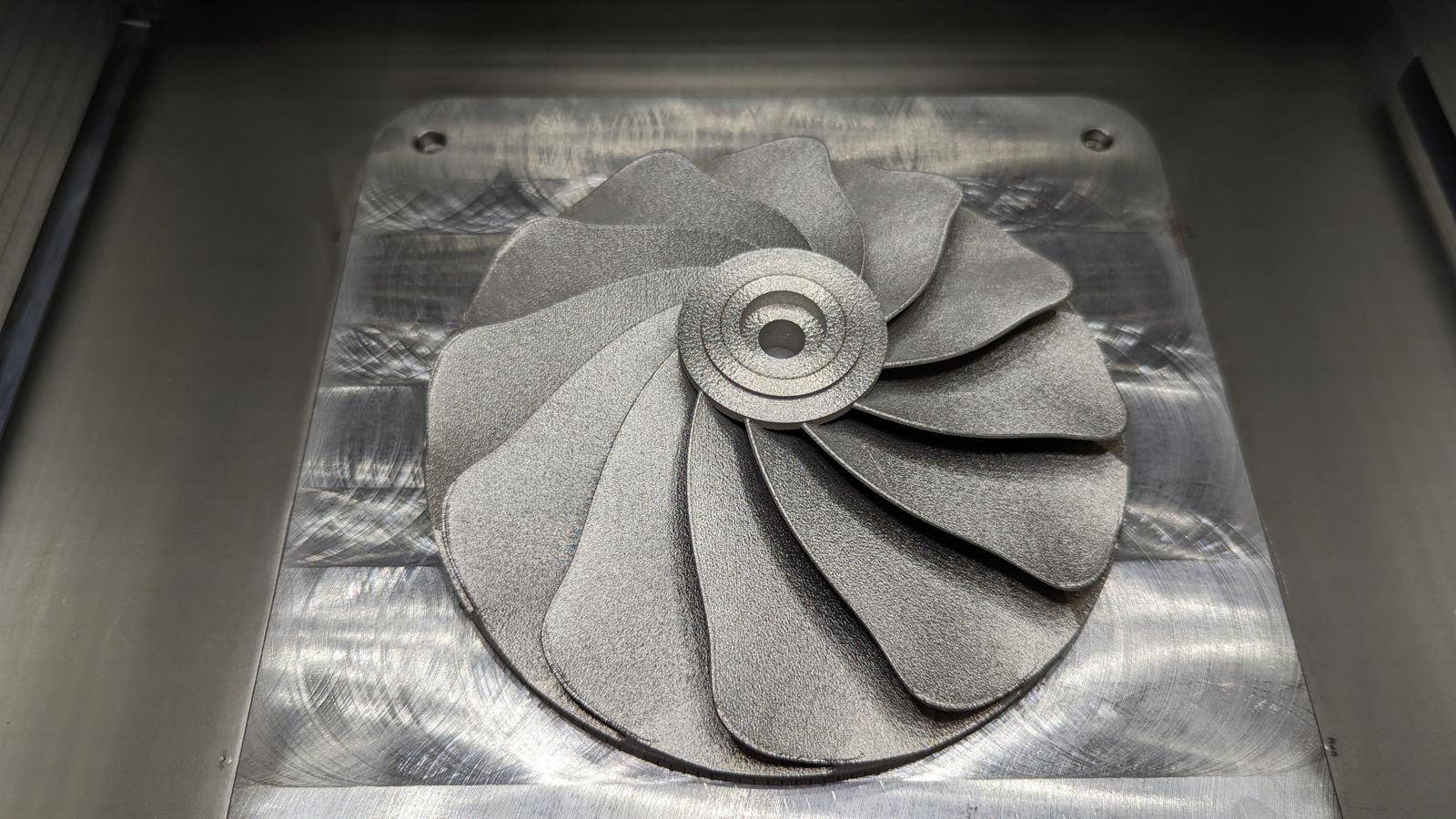
I love laser powder bed fusion. I have spent most of my career on it. That is exactly why I think we, as an industry, owe our customers a more honest conversation about money.
Trade-show stands show the part. Case studies show the weight saved, the parts consolidated, the lead time cut. Those stories are real. What they rarely show is the full cost of getting from a promising demonstration to a part that is accepted, delivered and repeatable. When a customer discovers those costs late, they lose trust in the technology, not just in the supplier.
I do not think anyone is deliberately hiding anything. But our habits of communication leave out the parts of the cost that are hardest to sell. Here are the ones I see most often.
Machine time is most of the bill
Most published cost models for metal powder bed fusion, going back to the work of Atzeni and Salmi and of Rickenbacher and colleagues, agree on one thing: machine time is usually the largest single share of the part cost. The machine is expensive, it depreciates whether it is printing or not, and builds take hours to days.
That has two consequences that brochures do not emphasize. First, powder price matters less than people think for most parts, and build time matters more. Second, utilization is everything. A machine that runs 40% of the year costs nearly twice as much per hour of useful printing as one that runs 80%. A quote that assumes high utilization is only honest if the shop actually achieves it.
The part is not finished when the laser stops
After the build, the part still has to be:
- depowdered, often carefully, with internal channels;
- stress-relieved, usually while still on the plate;
- removed from the plate, often by wire EDM or sawing;
- cleared of supports, by hand or by machining;
- heat-treated or hot isostatically pressed if the application needs it;
- machined on critical faces and features;
- surface-finished, if roughness matters;
- inspected, increasingly by CT for internal features.
In my experience, these steps can easily cost as much as the print itself, and sometimes much more. They also take calendar time, which is why “printed in 24 hours” and “delivered in 24 hours” are different promises.
Supports cost three times
Supports cost powder and laser time to build, labour and machining to remove, and surface quality where they were attached. Internal supports in closed channels may not be removable at all, which is what pushed my own doctoral research toward support-free overhangs.
When a design is quoted, I always ask how much of the build volume is support and how it will come off. That one question explains a surprising share of the difference between two quotes.
Failed builds are part of the price
Builds fail. Recoater crashes, distortion, lack of fusion in a difficult region, a power cut, a powder problem. A mature shop on a mature part has a low failure rate. A new part, a new material or a new machine does not.
The honest way to price this is to spread the expected cost of failed and rejected builds across the accepted parts. A quote based on a perfect first build is a best case presented as an expectation.
Development and qualification are real projects
The first good part is the beginning, not the end. For regulated industries, the process has to be qualified: parameter development, witness coupons, mechanical testing, sometimes fatigue, chemistry and CT, and documentation that ties every part back to its powder lot and machine. For a medical implant or a flight part, this can take months and cost far more than the first production batch.
None of this is a reason to avoid LPBF. It is a reason to count it. A business case that leaves qualification out will look excellent until the first audit.
Powder management is a running cost
Even when powder price is a modest share of the part cost, how powder is managed is not free. Sieving, storage, testing, traceability and retirement decisions all take labour and equipment. In two earlier articles I showed how a reuse policy alone can double the fresh powder a production cell needs each year.
People and software
Build preparation, orientation studies, simulation, parameter work, machine maintenance, gas, filters, operator time and engineering support all appear somewhere in the accounts. In smaller shops they are often absorbed into overheads and forgotten when quoting. They come back as thin margins.
What I would like us to do differently
I would like suppliers, machine makers and researchers to talk about cost per accepted part, not cost per build or cost per kilogram. I would like case studies to state the post-processing route and the inspection plan along with the weight saving. And I would like customers to be shown a realistic first-year cost, including development, before they commit.
The good news is that the honest version of the story is still a good story. LPBF earns its place when it delivers something conventional manufacturing cannot: internal channels, consolidated assemblies, lighter structures, shorter development cycles, or parts that are simply impossible otherwise. Those benefits are large enough that we do not need to hide the cost of reaching them.
The customers who come back for a second order are the ones who knew what the first one would cost.
Further reading
- Atzeni, E. and Salmi, A. (2012). Economics of additive manufacturing for end-usable metal parts. International Journal of Advanced Manufacturing Technology 62.
- Rickenbacher, L., Spierings, A. and Wegener, K. (2013). An integrated cost-model for selective laser melting. Rapid Prototyping Journal 19(3).
- Kumar, A. (2026). Why reuse beats recycling, and The oxygen budget, on this site.