“Digital twin” is one of the most used phrases in manufacturing today. I hear it in sales presentations, research proposals and job descriptions. Sometimes it means a sophisticated, live, physics-based model of a machine, synchronized with sensor data. Sometimes it means a 3D model with a dashboard.
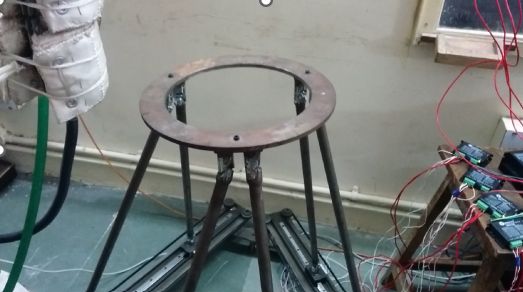
I have built robots by hand: a five-axis parallel manipulator, delta robots, and gantry and laser systems for deposition. I have programmed ABB and Fanuc robots for welding and deposition, and trained others to do it. That experience left me with a clear view of what a twin has to do before it earns the name.
What a digital twin is, and is not
A useful working definition has three parts:
- A model of a physical asset or process, at a level of detail chosen for a purpose.
- A connection that keeps the model synchronized with the real asset’s state, ideally automatically.
- A use: decisions or predictions that the model supports, which feed back to the physical world.
A CAD model is not a twin; it has no connection. A dashboard of sensor values is not a twin; it has no model. An offline simulation used once to plan a cell is valuable, but it is a digital model. It becomes a twin when it is kept in step with the real cell and used to act on it.
What robotics already does well
Robotics has had parts of the twin idea for decades.
Offline programming and simulation. Tools like ABB RobotStudio or Fanuc ROBOGUIDE let you build the cell, program paths, check reach and collisions and estimate cycle time before touching the robot. For deposition, the toolpath is generated from geometry, simulated, and posted to the controller.
Kinematic models. Every robot controller contains a kinematic model of the arm. Calibration adjusts that model to match the real robot more closely.
Monitoring. Modern controllers report joint positions, torques, temperatures and alarms. Many cells log them.
These are the building blocks. The twin is what happens when they are joined up.
Where the gap usually is
In my experience, the gap between the model and the real cell sits in a few predictable places.
Calibration and compliance. A robot’s nominal kinematic model is not the robot. Link lengths, joint offsets, gear backlash and the flexibility of the arm under load all cause errors. For pick-and-place, these are small. For deposition or machining, where the tool must follow a path within a fraction of a millimetre under process forces, they are not. The parallel manipulator I built behaved differently from its CAD model under load, and the difference only showed up when we measured it.
The workpiece. In additive and welding processes, the part changes shape as it is built. Distortion, bead height variation and thermal growth mean the real surface drifts away from the nominal one, layer by layer. A twin of the robot that ignores the part is half a twin.
The process. A deposition cell’s real product is a melt pool. Heat input, wire feed, gas flow and interlayer temperature decide whether a layer is good. Modelling the robot’s motion precisely while treating the process as a constant misses the point.
Data plumbing. Connecting controllers, process equipment and sensors from different vendors, with time-synchronized data, is often the hardest engineering job in the whole project, and the least glamorous.
A twin that earns its keep
The twins I find convincing are narrow and purposeful. A few examples of what that looks like:
- Adaptive deposition. Scan the part height after each layer, compare it with the model, and adjust the next layer’s path or deposition rate. The twin keeps the as-built geometry, not just the as-designed one.
- Thermal management. Track interlayer temperature with sensors, update a simple thermal model, and decide when the next layer can start.
- Predictive maintenance. Track joint torques and temperatures over time to spot wear before failure.
- Virtual commissioning. Test PLC logic and robot programs against a simulated cell before installation, to shorten commissioning on site.
Each one has a clear question, a model sized to that question, a data connection, and an action.
How I would start
For a team considering a twin, my advice is practical:
- Start with a decision. What would you do differently if you had the twin? If there is no answer, there is no twin.
- Measure the real system first. Calibrate the robot, characterize the process, and learn where the model and reality disagree.
- Model only what the decision needs. Full physics for everything is a research project, not a production tool.
- Build the data pipeline early. It will take longer than the model.
- Close the loop slowly. Use the twin to advise people first, then to act automatically once it has earned trust.
Building robots by hand taught me humility about models. The robot always knows something the CAD model does not. A good digital twin is simply an organized way of listening to it.
Further reading
- Grieves, M. and Vickers, J. (2017). Digital twin: mitigating unpredictable, undesirable emergent behavior in complex systems. In Transdisciplinary Perspectives on Complex Systems, Springer.
- ISO 23247 series. Automation systems and integration — Digital twin framework for manufacturing.