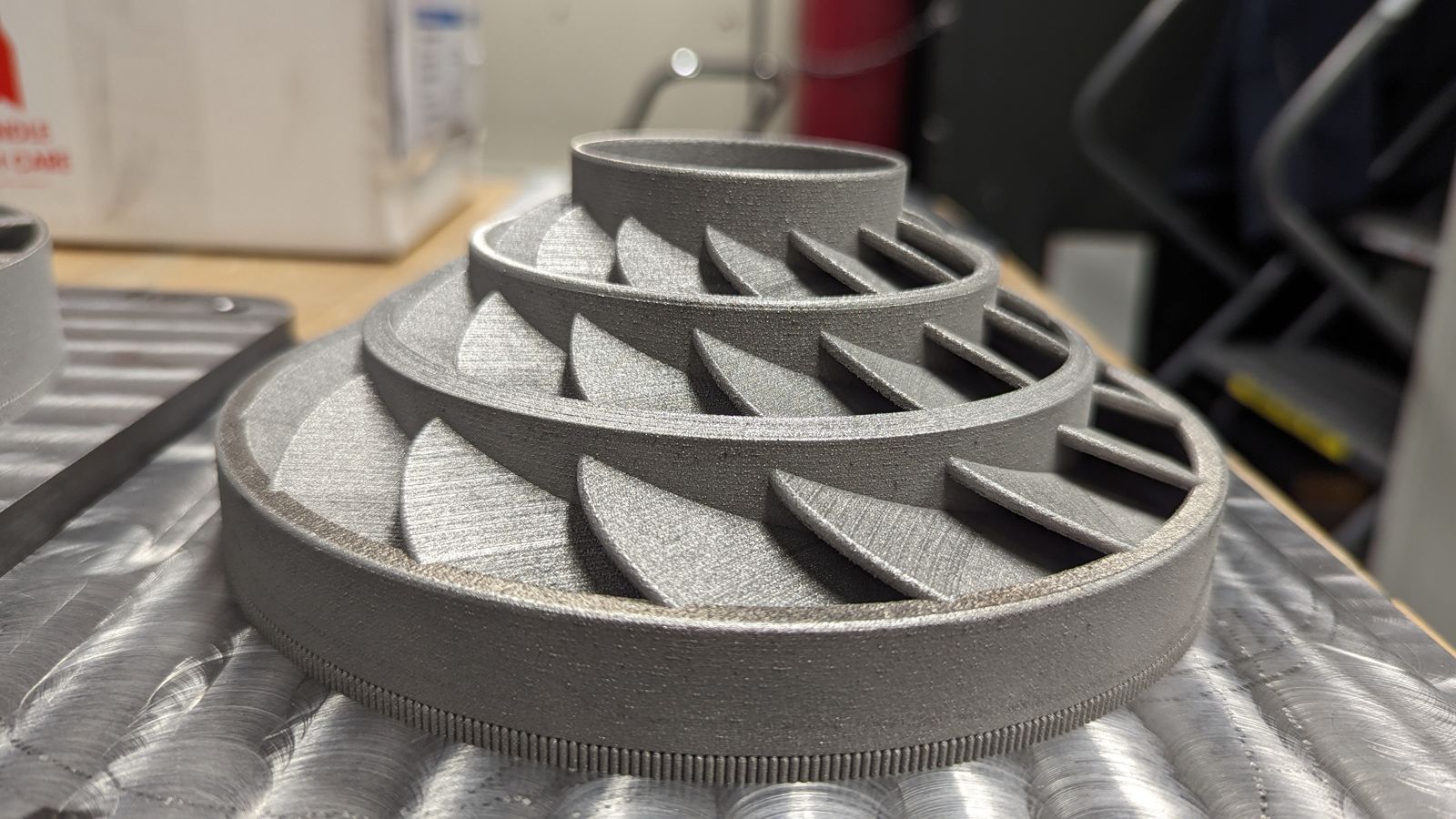
When I started in additive manufacturing, design meant a CAD model drawn by an engineer. The printer was the last step. Today, by the time a metal part is printed, algorithms have usually made more of the decisions than the engineer has. Topology optimization shapes the material. Lattice generators fill the volume. Build preparation software orients and supports the part. Slicers and hatch generators decide where the laser goes, and region-specific parameter sets change the energy layer by layer.
I find this exciting. I also think it changes what an engineer needs to be good at.
The layers of algorithmic design
It helps to separate the decisions algorithms make into levels.
Shape. Topology optimization removes material where stress is low and keeps it where load paths run. Generative design explores many candidate shapes against constraints. The result is often organic and lighter than a human would draw, and it is only manufacturable if the manufacturing constraints were part of the problem.
Structure. Lattices, gyroids and graded infills replace solid regions with repeating cells. They can be tuned for stiffness, energy absorption, heat transfer or bone ingrowth. They are defined by a few parameters and generated by code, not drawn.
Build. Orientation, nesting and support generation are optimization problems: minimize build height, support volume, distortion or time. Software does them faster than people, but the objectives are set by people.
Process. Scan vectors, hatch spacing, contours, island patterns and region-specific parameters are generated for every layer. In my own work on support-free overhangs, the key step was an algorithm that changed laser parameters according to how much solid material lay under each region. That is algorithmic design at the scale of the melt pool.
What algorithms are good at
Algorithms are excellent at exploring large design spaces, keeping many constraints in view at once, and applying rules consistently to thousands of layers and millions of scan vectors. They do not get tired, and they do not forget the 47th constraint.
They are also how the digital thread becomes real. When geometry, build file, process parameters, machine logs, inspection data and material certificates are all linked, a part can be traced from design intent to the as-built result. That traceability is what regulated industries need before they trust AM.
What algorithms are bad at
Algorithms optimize what you ask them to optimize. Common gaps I have seen:
- Missing constraints. A topology-optimized bracket that needs supports in impossible places, or a lattice that traps powder, because overhangs and depowdering were not in the objective.
- The wrong load case. An optimized part is excellent for the loads you modelled and fragile for the ones you forgot. Real parts see handling, assembly, vibration and misuse.
- Fatigue and surface. Most shape optimization works on static stiffness or strength. As-built AM surfaces are rough, and fatigue lives where geometry, roughness and residual stress meet.
- Manufacturing variation. A thin strut that works at nominal size may fail at the low end of what the machine actually produces.
- Inspection. A design that cannot be measured cannot be qualified. Complex internal lattices may only be inspectable by CT, and only to a point.
Where the engineer stays essential
I do not think algorithmic design replaces engineers. I think it moves their work.
Defining the problem becomes the most important design step. Which loads, which constraints, which manufacturing limits, which objective? A good definition with an average optimizer beats a poor definition with an excellent one.
Knowing the process becomes more valuable, not less, because the constraints have to come from somewhere. Minimum feature size, overhang limits, distortion, surface roughness and powder removal are all measured on real machines. Generic values are a start. Machine- and material-specific values, like the ones I developed for IN625 on a Renishaw AM400, are what make generated designs printable.
Judging the result still needs experience. When a generated design looks wrong, an experienced engineer can usually say why, and that intuition is hard to encode.
Validating remains physical. Builds, coupons, CT and mechanical tests close the loop that simulation opens.
What I would like to see next
The field is moving toward closing the loop: in-situ monitoring that feeds back into the process, process data that informs the design rules, and design tools that know the limits of the specific machine they are designing for. AI and machine learning will help with parts of this, particularly in sorting large amounts of monitoring and inspection data.
I co-organized a symposium on AI and machine learning for data-driven manufacturing at ASTM ICAM 2026 because I believe this is where much of the next decade’s progress will come from. But I also left every session with the same thought: the algorithms are only as good as the physical understanding and the data behind them. The best digital manufacturing teams I know are full of people who still enjoy being in the lab.
Further reading
- Bendsøe, M.P. and Sigmund, O. Topology Optimization: Theory, Methods and Applications. Springer.
- ISO/ASTM 52910. Additive manufacturing — Design — Requirements, guidelines and recommendations.
- Kumar, A. et al. (2026). From generic DfAM rules to machine- and material-specific design frameworks: an industrial case study in Inconel 625 LPBF. HI-AM 2.0 Conference.