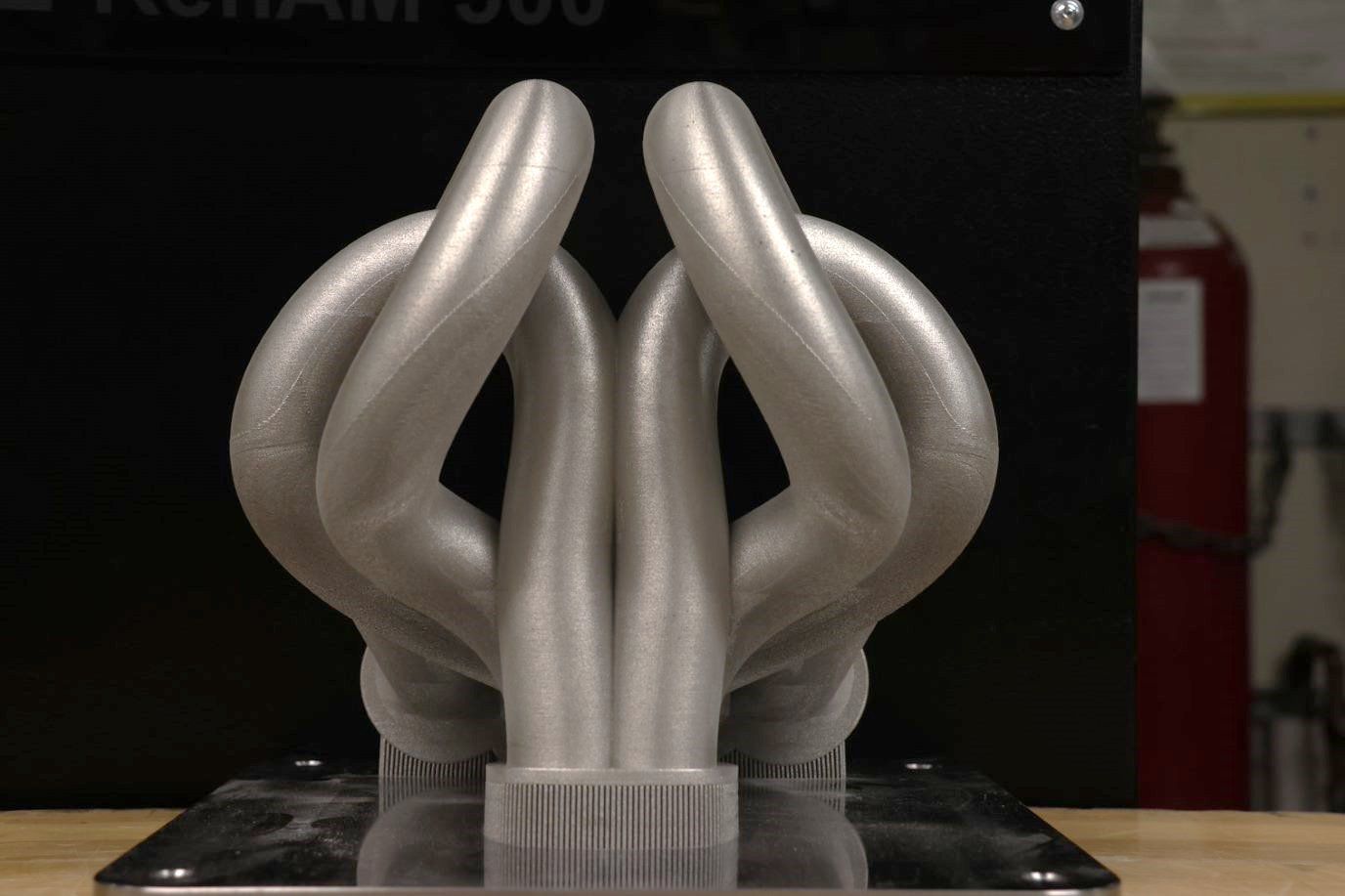
Almost every introduction to metal additive manufacturing shows the same kind of slide: twenty welded and brazed parts on the left, one printed part on the right. The GE fuel nozzle tip is the best-known example, and it deserves its fame. I use it in my own courses.
Part consolidation is a real advantage of AM. But after years of design reviews, I have come to think it is also the most over-applied idea in the field. An assembly exists for reasons. Before we print it as one piece, we should know what those reasons were.
Why we make assemblies at all
Engineers did not design assemblies because they enjoyed bolts. Each joint usually exists for one of these reasons:
- Manufacturing: the shape could not be machined, cast or formed in one piece.
- Materials: different parts need different materials, a hard seat in a soft body, a conductor in an insulator.
- Motion: parts must move relative to each other.
- Maintenance: a part wears and must be replaced without scrapping the rest.
- Inspection: surfaces must be reached to be measured or checked.
- Assembly and logistics: the product is too big to make or ship in one piece, or the parts come from different suppliers.
- Tolerance: a joint allows adjustment to absorb manufacturing variation.
AM removes the first reason for many parts. It does not remove the others. Consolidation pays off when the joint was there mainly for manufacturing, and it backfires when the joint was there for one of the other reasons.
When consolidation pays off
In my experience, a consolidated AM part is worth serious consideration when:
- Joints are a source of failure. Brazes, welds and seals can leak or crack. Removing them removes failure modes and inspection steps. Fluid systems, manifolds and heat exchangers are classic cases.
- Assembly labour is a large share of cost. Many small parts, many fixtures, many inspection points.
- Internal geometry matters. Smooth internal flow paths, conformal channels and integrated cooling are hard or impossible with assembled parts.
- Weight and space are critical. Flanges, fasteners and overlaps add mass that a single part does not need.
- The supply chain is long. Each part in an assembly is a purchase order, a supplier and a lead time. One part is one of each.
When it backfires
Consolidation tends to go wrong when:
- One feature wears faster than the rest. If a seat or a bearing surface wears, the whole part goes in the bin.
- Critical surfaces can no longer be reached. You cannot machine, polish or measure what you cannot get a tool or a probe to. Internal surfaces that needed a fine finish are a common trap.
- Powder cannot get out. Closed internal volumes trap powder. Every cavity needs an escape route that does not compromise the design.
- Failure is all-or-nothing. A defect in one region of a consolidated part scraps all of it, and AM parts can be expensive to scrap.
- Different materials were the point. Multi-material AM exists but is far from routine.
- The consolidated part does not fit the machine or would take so long to build that the cost advantage disappears.
- Certification has to start again. In regulated industries, a consolidated design is a new part with its own qualification. That cost can outweigh the savings for a low-volume product.
A middle way: designed-for-AM assemblies
The most effective designs I have seen are often not single parts. They are assemblies of a few AM parts, each designed around what printing does well, joined where joining makes sense.
- Consolidate the complex core, the part with the internal channels, and keep wear parts, seals and standard components separate.
- Print interfaces that make assembly easy: self-locating features, snap fits in polymers, integrated threads or thread inserts, alignment pins.
- Split large parts deliberately to fit the build volume, reduce supports and allow inspection, with joints placed where stress is low.
- Print-in-place mechanisms, such as hinges or captive parts, can work well in polymers. In metals they need generous clearances and careful depowdering, and I would test them before trusting them.
A short decision checklist
When a team proposes consolidating an assembly, I ask them to go joint by joint:
- Why does this joint exist? Manufacturing, material, motion, maintenance, inspection, logistics or tolerance?
- If it was only manufacturing, can AM make that shape, and at what cost?
- If it was anything else, what replaces that function in the consolidated design?
- Can every critical surface still be finished and inspected?
- How will powder be removed from every internal volume?
- What does a defect cost now: one small part, or the whole assembly?
- What has to be requalified, and who pays for it?
If the answers are good, consolidate with confidence. If not, the better design is usually a smarter assembly, not one heroic part.
Further reading
- Boothroyd, G., Dewhurst, P. and Knight, W. Product Design for Manufacture and Assembly. CRC Press.
- ISO/ASTM 52910. Additive manufacturing — Design — Requirements, guidelines and recommendations.