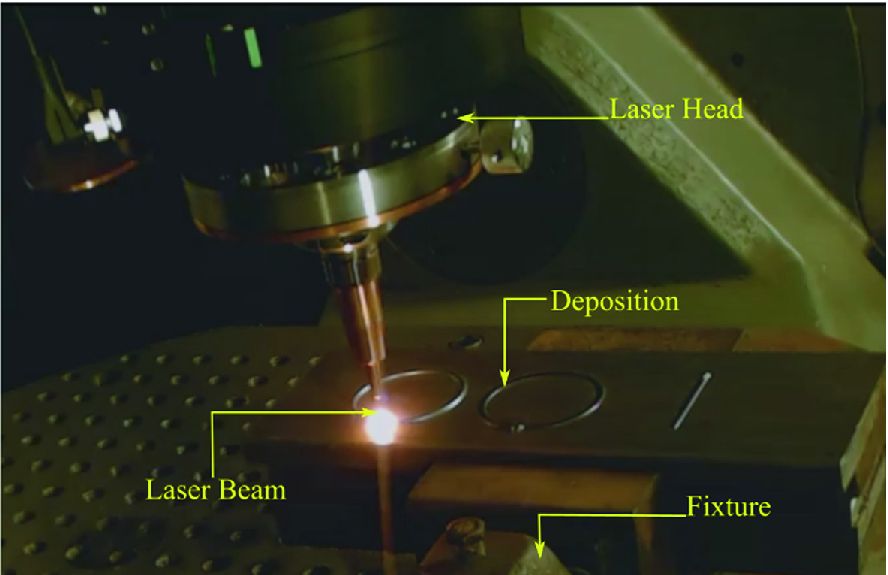
I have worked with both families of metal additive manufacturing. My doctoral work was in laser powder bed fusion (LPBF). Before and around it, I built robots, retrofitted a laser head onto a CNC for wire cladding, and deposited metal with TIG and MIG torches on a five-axis machine. The same question kept coming up from engineers new to AM: “Can I use the same design rules for both?”
The short answer is no. The longer answer is more interesting, because the differences come from the physics of each process, and once you see them, the rules follow naturally.
Two different machines
LPBF spreads a thin layer of powder, typically 20 to 100 µm, and melts selected areas with a focused laser. The part grows inside a bed of loose powder, layer by layer, on a fixed build plate. The melt pool is tiny and fast, so features can be fine and accuracy is high, but build volumes are limited and deposition rates are low.
Directed energy deposition (DED) feeds powder or wire into a melt pool created by a laser, electron beam or arc, and moves the head (or the part) along a path. The melt pool is larger, the material goes only where it is needed, and parts can be big. Deposition rates are much higher, but resolution and surface quality are lower, and most DED parts are machined afterwards.
That one difference, a bed of powder versus a moving head, drives almost everything below.
Overhangs and supports
In LPBF, the build direction is fixed. Any downward-facing surface below roughly 45° from horizontal tends to need supports, because the loose powder below cannot carry heat away and the melt pool sags. Much of my research was about pushing that limit down, and it can be pushed, but it is still the central design constraint.
In multi-axis DED, the build direction can change during the build. If the head or the part tilts, an “overhang” can be built as if it were vertical. With a five-axis machine or a parallel robot, I have deposited features that would need heavy supports in a powder bed. The constraint moves from overhang angle to reach: can the head get there without colliding with the part, the fixture or itself?
So in LPBF you design around gravity and heat. In DED you design around access and toolpaths.
Feature size and resolution
LPBF can produce thin walls of a few hundred micrometres, fine lattices, small holes and internal channels a few millimetres across. Its limits are set by the laser spot, the powder size and how well the area around the feature can conduct heat.
DED walls are usually several millimetres thick, set by the bead width. Fine lattices and small internal channels are not realistic. DED shines on larger, simpler forms: flanges, bosses, near-net-shape preforms, and features added to an existing part.
Internal channels
This is LPBF’s signature strength. Conformal cooling, manifolds and heat exchangers with internal passages are where powder bed parts earn their price. The design rules are about the channel’s cross-section (round channels often become teardrops or diamonds to be self-supporting), its minimum size, and above all how the powder will get out.
DED can make hollow parts, but internal channels with complex routing are generally not practical. If a design depends on internal passages, it is usually an LPBF design.
Machining allowance and datums
Almost every DED part is machined, so the design must include stock allowance on critical surfaces, often a millimetre or more, and datum features the machinist can locate from. Designing the hybrid route, deposition then machining, is part of DfAM for DED.
LPBF parts are often machined too, on sealing faces, bearing bores and threads, but less material is added. The design must still say which faces will be machined and allow for removal from the build plate, usually by wire EDM.
Residual stress and distortion
Both processes build in residual stress, but in different ways. LPBF has very steep thermal gradients over small regions, so stress builds up layer by layer and the part can curl or crack, especially on large flat areas. Design responses include avoiding large cross-sections parallel to the plate, adding ribs or fillets, choosing orientation carefully, and planning stress relief before removal from the plate.
DED puts much more heat into the part. Distortion of the whole part and of the substrate is common, and interpass temperature control, deposition sequence and fixturing matter as much as the geometry.
Material and microstructure
The same alloy will not have the same properties from the two processes. LPBF’s rapid cooling gives very fine microstructures and often higher as-built strength. DED’s slower cooling and repeated reheating give coarser grains, and the properties depend on the deposition path. Design allowables have to come from data for the process actually used, not from a datasheet for the other one.
Repair and hybrid parts
DED can add material to existing parts. That makes it attractive for repairing worn components, adding features to forgings or castings, and cladding with a different alloy. Design for repair is a different mindset: the existing part is the substrate, and the job is to restore it without damaging it.
A quick way to choose
When I help someone decide, I ask four questions:
- Does the part need fine features or internal channels? If yes, start with LPBF.
- Is it large, or mostly simple shapes that will be machined anyway? If yes, look at DED.
- Is it a repair or an addition to an existing part? DED is usually the natural route.
- What does the whole route cost, including machining and inspection? The process that wins on the printer does not always win on the delivered part.
The best DfAM work I have seen starts from the process and works back to the geometry. Generic rules are a good start, but as I found in my industrial work on IN625, the rules that really work are the ones measured on your own machine with your own material.
Further reading
- ISO/ASTM 52910. Additive manufacturing — Design — Requirements, guidelines and recommendations.
- ISO/ASTM 52911-1. Additive manufacturing — Design — Laser-based powder bed fusion of metals.
- Kumar, A. et al. (2026). From generic DfAM rules to machine- and material-specific design frameworks: an industrial case study in Inconel 625 LPBF. HI-AM 2.0 Conference.