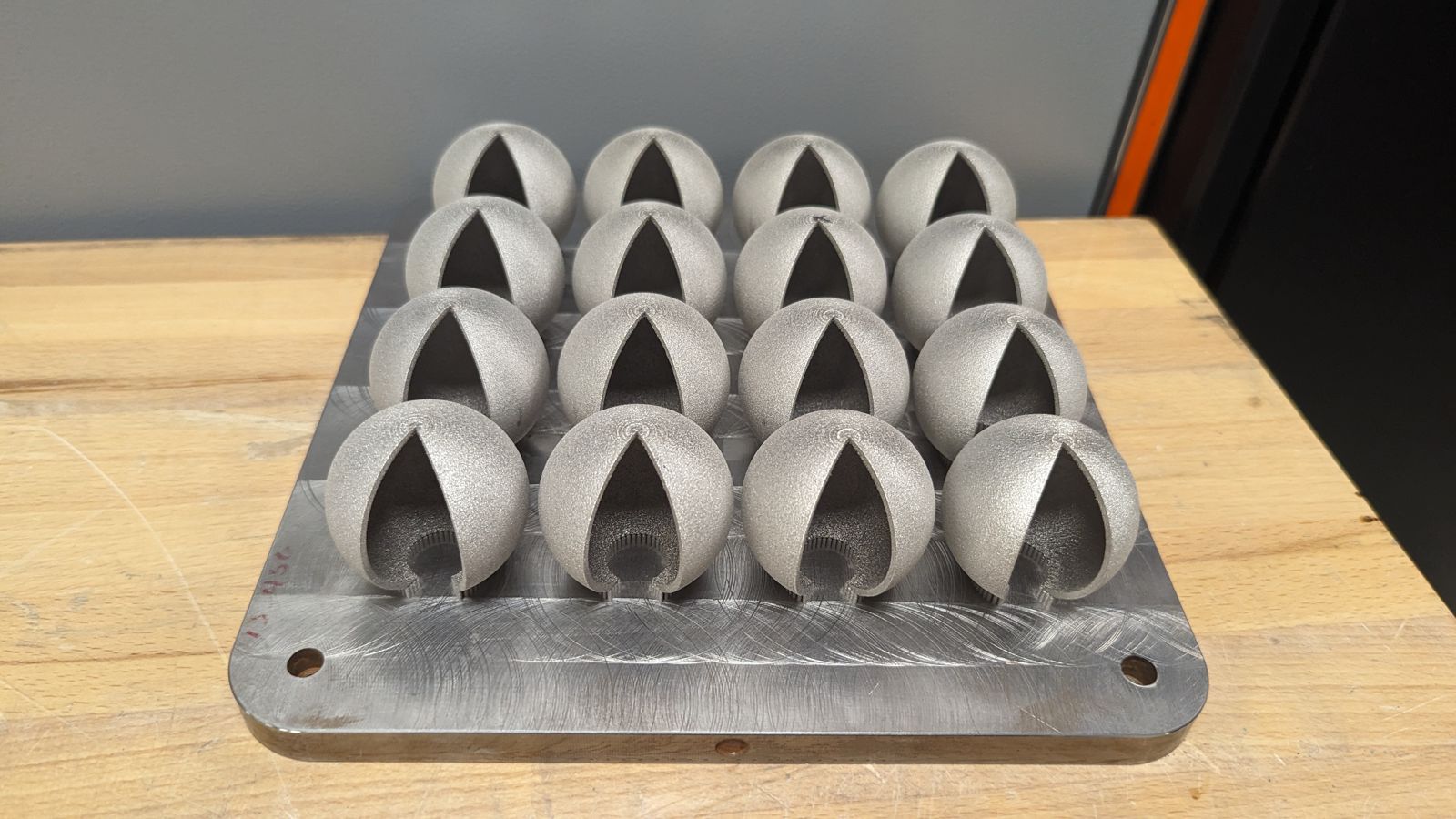
When people outside additive manufacturing first see a laser powder bed fusion machine, they are surprised by how little of the powder ends up in the part. A typical build fuses a small fraction of the charge. The rest supports the part, absorbs heat and spatter, and then comes back out of the machine waiting for a decision.
That decision, keep it or retire it, quietly drives a large share of a production cell’s material cost. I spent some time this autumn modelling it for titanium, Ti-6Al-4V, at a production rate of about 100 builds a year. The numbers changed how I think about the word “recycling”.
Start with a mass balance, not a price
The model is simple. Each build is charged with 200 kg of powder. About 20 kg is fused into parts, supports and test coupons. About 5 kg is lost to sieving, sampling, spills and extraction. The remaining 175 kg is unfused and, if it conforms, can go back into the next build with 25 kg of fresh top-up.
Three numbers already tell a story:
- The machine handles 20,000 kg of powder a year, but that figure counts the same circulating material again and again. It is throughput, not purchasing.
- If conforming powder is retained, the cell needs about 2,500 kg of fresh powder a year: what is fused plus what is lost.
- The recovery rate of unfused powder is about 97%. Cutting handling loss from 5 kg to 3 kg raises it to about 98%, which saves around 200 kg a year.
None of this needs a spreadsheet to understand. It needs someone to weigh what goes in and what comes out, separately, every time.
A reuse cap is a retirement policy
Many shops manage reuse with a fixed rule: retire the whole pool after six uses, or after ten. These rules feel conservative and easy to audit, and sometimes they are exactly what a customer or a specification requires.
But a reuse cap is really a batch-retirement policy, and its cost is easy to underestimate. In my model, retiring the entire recovered pool after every sixth build raises annual fresh-powder demand from about 2,500 kg to about 5,300 kg. A ten-use cap gives about 4,250 kg. Retiring after every single build, the extreme case, needs about 20,000 kg.
At an illustrative CAD 200 per kilogram, the gap between a ten-use cap and a qualified top-up process is roughly CAD 350,000 a year for one cell. That is real money, and it is spent on powder that, in many cases, still met its specification on the day it was retired.
I want to be careful here. Neither six nor ten is universally right or wrong. The point is that the number should come from evidence about the powder and the parts, not from habit.
Top-ups do not reset the clock
The usual alternative to a cap is to top up the recovered powder with fresh material. It is the cheaper option, but it brings its own subtlety: mixing dilutes old powder, it does not remove it.
With a 12.5% fresh fraction per build and uniform mixing, the share of the original powder still in the pool falls to about 45% after six builds, 26% after ten and 7% after twenty. The average age of the pool settles at around seven previous exposures, but some particles are much older than that. An acceptable average does not override a hard limit on the oldest material, and good traceability means knowing the parent lots in every blend.
Why I say reuse beats recycling
Recycling, in the sense of sending retired powder back to be remelted or reprocessed, recovers some residual value. It is useful and it belongs in the plan. But it recovers that value at a large discount, after the material has left the qualified process.
Reuse keeps conforming powder working inside the process it was qualified for. Treated properly, powder is closer to tooling than to a consumable: you pay for it once, maintain it, inspect it, and retire it when the evidence says so. Good reuse practice saves more than any recycling credit can return.
That only holds if the reuse is earned. Sieving separates particles; it does not remove dissolved oxygen. Changing sieve cuts to keep unsuitable material is not a saving. Blending fresh powder into a pool that has already gone out of specification, to bring the average back, is not acceptable either, and some standards prohibit it explicitly. NASA-STD-6030 is one example.
What a defensible reuse practice looks like
From the literature and my own experience, the practical route has four steps.
- Establish the baseline. Weigh the charge, fused mass, retained powder, sieve reject, sampling loss and spills separately. Record every parent lot, blend, exposure and retirement reason.
- Characterize degradation. Compare virgin, recovered and blended powder: oxygen, nitrogen and hydrogen, size distribution, morphology, flow and apparent density. Pair powder results with chemistry and properties of parts or coupons from the same builds.
- Qualify the change. Use checkpoints across a realistic number of builds and several lots, include worst-case builds, and test what the application needs. For a structural or medical part that includes ductility and fatigue, not only strength and chemistry.
- Control it in production. Enforce the most restrictive of the quality, history and contract limits, and report fresh kilograms per accepted kilogram of parts, not just powder bought.
For medical devices, FDA guidance asks manufacturers to describe their reuse scheme and show that it does not harm the final device, and ASTM F3456 gives a common way to describe that scheme. Neither gives a universal reuse count. That number is yours to justify.
Where the opportunity sits
The strongest case for better reuse is a producer who is retiring powder that still conforms, at a meaningful production volume, with the authority to qualify a change. For that producer, closed recovery, sealed storage, routine testing and traceable blending can cut fresh-powder demand by close to half compared with a ten-use cap, as long as oxidation is controlled.
The next article in this series looks at that last condition. Oxygen, not cycle count, is often what really limits how long titanium powder can stay in service.
The figures here come from a deterministic model with stated, illustrative assumptions for price, losses and oxygen pickup. They are not measurements from a particular facility.
Further reading
- Harkin et al. (2020). Reuse of Grade 23 Ti6Al4V powder during the laser-based powder bed fusion process. Metals 10, 1700.
- Harkin et al. (2022). Powder reuse in laser-based powder bed fusion of Ti6Al4V. Materials 15, 2238.
- Koushik et al. (2023). Effective Ti-6Al-4V powder recycling in LPBF additive manufacturing considering powder history. Sustainability 15, 15582.
- ASTM F3456-22. Standard guide for powder reuse schema in powder bed fusion for medical applications.
- US FDA (2017). Technical considerations for additive manufactured medical devices.
- NASA-STD-6030 (2021). Additive manufacturing requirements for spaceflight systems.