Ask anyone who designs for laser powder bed fusion about overhangs and you will hear the same number: 45 degrees. Below that angle from the horizontal, add supports. It is one of the first rules every DfAM course teaches, including mine.
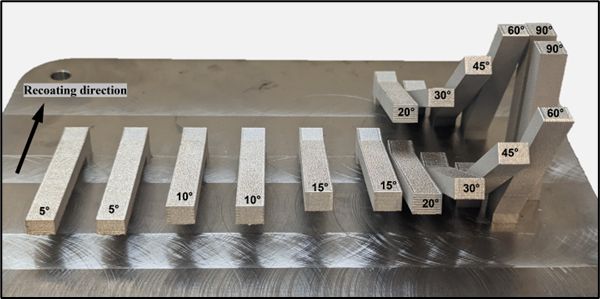
I spent my doctorate trying to break that rule. By the end, my colleagues and I were printing IN625 overhangs down to 5° without supports, and closed impellers whose internal blades could never have been supported in the first place. So I am often asked whether the 45° rule is obsolete.
My answer is no. It is a good default. But it is a rule about physics, not a law of nature, and understanding the physics tells you when and how you can move it.
Why the rule exists
When the laser melts a layer over solid metal, heat flows quickly down into the part. When it melts a layer over loose powder, it does not. Powder conducts heat poorly, perhaps one-hundredth as well as the solid metal, so the heat has nowhere to go.
On a steep wall, each new layer sits mostly on solid metal from the layer below. On a shallow overhang, more and more of each layer sits on powder. The consequences pile up:
- The melt pool grows and sinks into the powder, leaving a rough, drossy downskin.
- Heat accumulates at the overhang’s edge, so the local temperature climbs build after build.
- The thin edge curls up as it cools and contracts, and can catch the recoater blade.
- Residual stress concentrates where the hot overhang meets the colder body of the part.
Supports fix all of this at once. They carry heat away and hold the edge down. They also cost powder, laser time, removal labour and surface quality, and they cannot reach inside closed channels. That last point is what made the problem worth six years of my life.
How the rule can move
If the problem is that an overhang receives the same energy as a well-supported region but cannot get rid of it, then the solution is to change the energy where the geometry changes.
The approach we developed is geometry-based and feed-forward. Before the build, the software looks at each region of each layer and how much solid material lies underneath it. Downskin regions over powder get different laser parameters from the core: typically less energy and different scan settings, so the melt pool stays small and shallow. The adjustment is made in advance from the geometry, rather than by reacting to sensors during the build.
With careful parameter development, this took us from bars to closed impellers, at two scales and two layer thicknesses. The thinner 30 µm layers made the lowest angles possible, because each layer protrudes less over the powder.
What you pay for breaking it
This is the part I most want designers to hear. Printing a low overhang without supports is possible. It is not free.
- Surface roughness. Downskin surfaces are rougher than vertical walls and much rougher than upskins. The lower the angle, the rougher they get. If the surface matters for flow, fatigue or sealing, plan to finish it, or accept the roughness in the design.
- Residual stress. In our measurements, lower overhang angles showed higher tensile stress near the upskin surface. That matters for fatigue and for distortion.
- Microstructure. Different energy and cooling in the overhang region give a different grain structure and cell size from the core. Properties are not perfectly uniform across the part, and post-build heat treatment becomes part of the design.
- Process window. Support-free parameters are tuned to a machine, a powder, a layer thickness and a geometry. Move any of them and you may need to tune again.
- Development time. The first support-free part takes longer to develop than the first supported one. The payoff comes when you make many of them, or when supports were impossible anyway.
When to go support-free
In my view, support-free low-angle printing makes the most sense when:
- Supports cannot be removed, as with internal blades, closed channels or enclosed cavities.
- Supports damage a critical surface that would be expensive or impossible to finish afterwards.
- The part is made in volume, so development cost is shared across many builds and removal labour adds up.
- Support removal dominates the cost or lead time of the post-processing route.
When none of these apply, a well-designed supported part is often the cheaper and faster choice. Reorienting the part, splitting it into two, or changing the angle by ten degrees can remove the problem altogether, and a good designer should try those first.
The design conversation I would like to have
Instead of “is it below 45°?”, I would like designers and process engineers to ask together:
- How much of each layer sits over powder, and where?
- Can the orientation or the geometry reduce that?
- What roughness and stress can this surface tolerate?
- Who will tune the downskin parameters, and on which machine?
- What will the heat treatment do to the overhang region?
The 45° rule is a summary of all these questions for people who do not have time to ask them. When you do have the time, and the part deserves it, the answers can take you a long way below 45°.
Further reading
- Kumar, A., Shandiz, M.A., Kumar, M., Jena, A. and Brochu, M. (2025). Support-free fabrication of IN625 low-angle overhang structures using laser powder bed fusion. Materials & Design. doi:10.1016/j.matdes.2025.114873
- Kumar, A., Shandiz, M.A., Sikan, F. and Brochu, M. (2023). Microstructural and mechanical properties of an internal support-free IN625 closed impeller manufactured via L-PBF. Materials Science and Engineering A 874. doi:10.1016/j.msea.2023.145080
- Kumar, A. (2024). Laser powder bed fusion of support-free overhang structure. Ph.D. thesis, McGill University.